May 9, 2022
Global powerhouses flocking to Australia's offshore renewably energy industry
Late last year, the Australian Government released its long-awaited offshore energy infrastructure framework, laying the legislative foundations for ocean-based renewable energy generation and transmission.
Consultation closed last month on the draft offshore electrify infrastructure regulations and licensing scheme guidelines, and the related Acts are due to commence by June this year. While the details are still being hammered out, global energy majors are already moving in.
CoreMarine is working with several national and international players who see huge potential in Australia’s huge coastlines. We share their excitement: offshore renewable energy – particularly floating offshore wind – will play a key role in Australia’s future energy mix.
What do the new regulations cover?
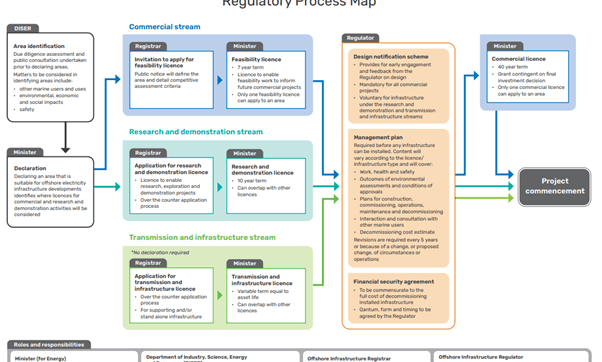
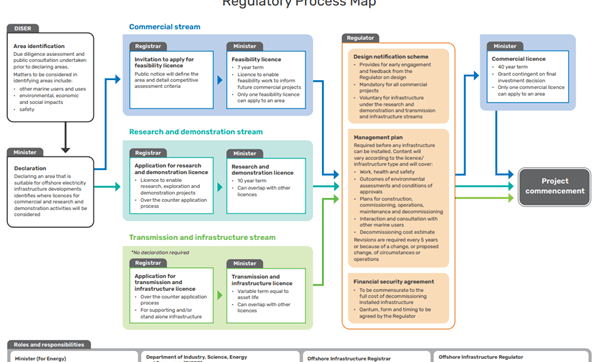
The legislative framework consists of the Offshore Electricity Infrastructure Act 2021 (OEI Act), Offshore Electricity Infrastructure (Regulatory Levies) Act 2021, the Offshore Electricity Infrastructure Regulations (Draft Regulations) and Offshore Electricity Infrastructure Licensing Scheme Guidelines (Draft Guidelines).
For developers considering a move into offshore electricity infrastructure, the new Australian regulations set out:
- The application requirements for each type of licence under the OEI Act
- The process for offering and granting of licences
- Further information on the matters to be considered by the Minister in deciding whether a licence meets the merit criteria, in deciding whether to grant a licence
- Process for extending and varying licences
- The conditions to which licences are subject. The Regulations currently only contain one licence condition, which is that a licensee must annually report to the Registrar with prescribed requirements
- Process and criteria for transferring licences or for change in control of the licence holder
- Procedural fairness provisions for when the Minister proposes to refuse to grant / extend / vary etc a licence, in particular inviting the applicant to make a written submission about the proposed decision
- Application fees are yet to be specified in reg 200.
Source: NOPSEMA
Our key takeaways
Taking our lead from existing schemes
We see parallels between plans to regulate and develop the Australian industry with the most recent ScotWind leasing round. Under ScotWind, areas of seabed off the coast of Scotland are leased to developers who successfully apply to develop a windfarm in those waters.
There are also similarities with oil and gas leasing arrangements. The National Offshore Petroleum Safety and Environmental Management Authority (NOPSEMA) has been looped in here as the offshore infrastructure regulator.
Checking the boxes
To win a lease, a developer will need to successfully address four merit criteria:
- Technical and financial
- Viability
- Applicant suitability
- National interest.
These are at the Minister’s discretion. Developers need to be aware that ‘applicant suitability’ may hinge on “past performance in offshore infrastructure projects in Australia or internationally”. A heads up for developers who come from outside the offshore industry: this means you’ll most likely need to have an experienced industry partner on board, e.g. Shell, Orsted, Iberdola, BHP etc.
Lease areas
The OEI (Regulations) limit the maximum commercial license area to 700km2. This is designed to drive optimisation of seabed lease areas, limiting a development to roughly 3GW (based on projected typical turbine size in 5-10 years).
While there is nothing in the legislation stopping side-by-side developments for a larger total capacity, developers will be identifying and bidding for a lease area within a development region. This means we could see proponents competing for overlapping lease areas – in which case, the highest bidder would win.
Why we are backing wind?
Australia is fortunate to have amazing ocean resources, especially wind. With an electricity-dependent population concentrated at the coast and in big cities, it lends itself to a successful offshore wind industry.
We see that the initial offshore wind industry will be focused on the south-east corner of Australia with large population density and the phasing out of coal-fired power stations.
Further to this is the exciting interplay between renewable energy and hydrogen production in Tasmania, with plans underway to export ammonia (as the carrier for hydrogen) from Tasmanian ports soon.
A holistic view of offshore wind and hydrogen production also plays into the 4th merit criterion around ‘national interest’.
CoreMarine and renewable offshore wind
We love offshore energy. CoreMarine works on offshore renewables projects from end to end, from feasibility, development, engineering design, construction to O&M, including our own software to optimize operations and predictions.
We’re especially bullish on floating offshore wind and are industry leaders in developing floating concepts from idea to installation.
CoreMarine’s offshore floating wind partners and clients include Iberdrola, Sevan and Seatwirl. Have a look at Our Projects.